FragileWE

SOLO PROJECT / ONLINE MULTIPLAYER & GESTURE INTERACTION
Role Concept to Execution
Tools p5.js, ml5.js, Gemini, Illustrator
Format Interactive & Multiplayer Artwork
Year 2026
FragileWE Hero
Concept

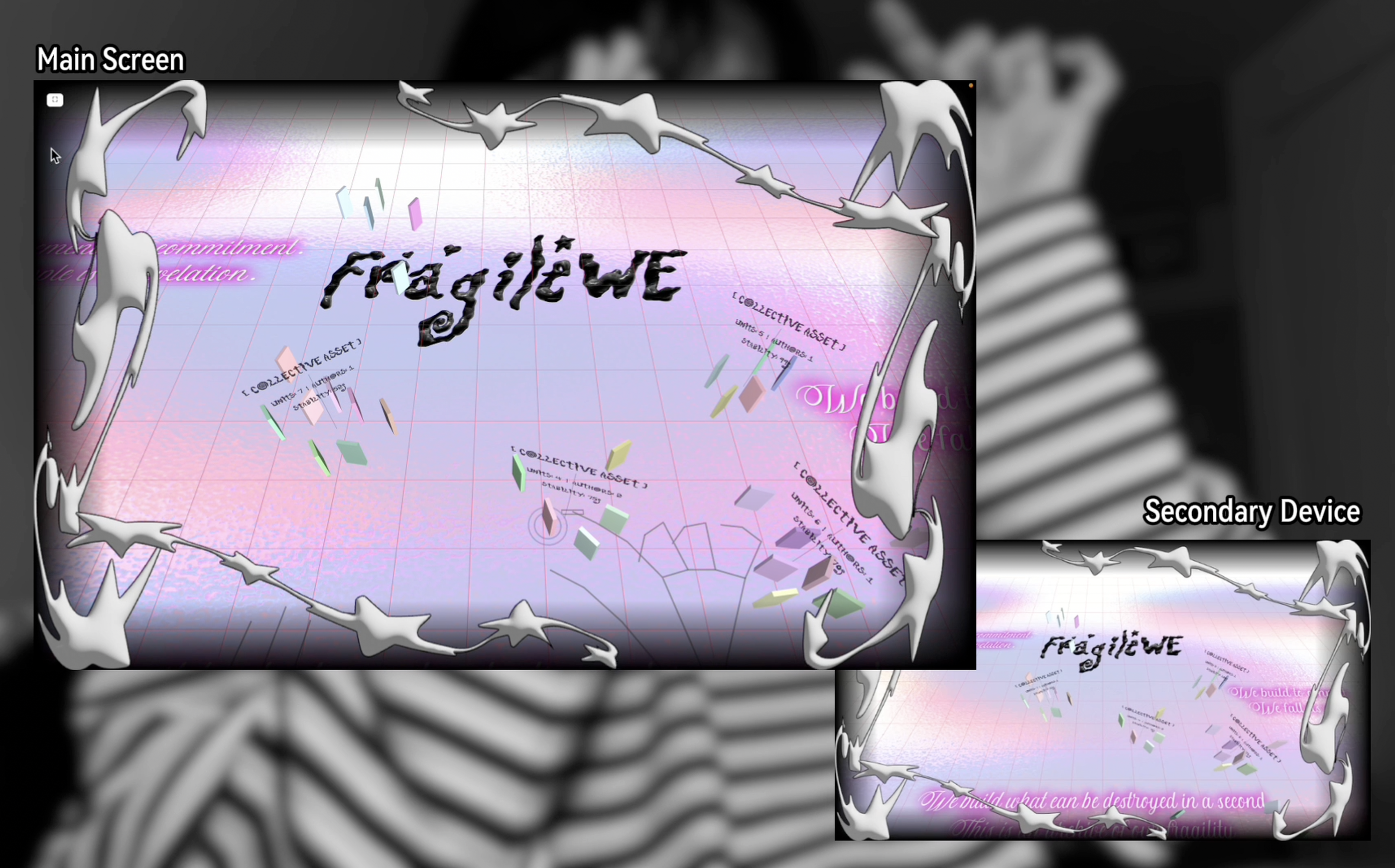
"FragileWE 2.0" is an interactive, multiplayer computational artwork exploring the terrifying asymmetry between the immense effort required to build and the ease of destruction. In this shared online space, anonymous users collaboratively place digital dominoes. These dominoes act as fragile "collective assets" and social contracts—taking minutes of careful collaboration to construct, but only seconds to collapse entirely in a chain reaction.

Inspired by Olafur Eliasson’s physical installations, this project translates the concept of collective building into the digital realm. By algorithmically amplifying the stark contrast between creation and destruction, it illustrates human vulnerability against cold computational logic.
Interaction Mechanics

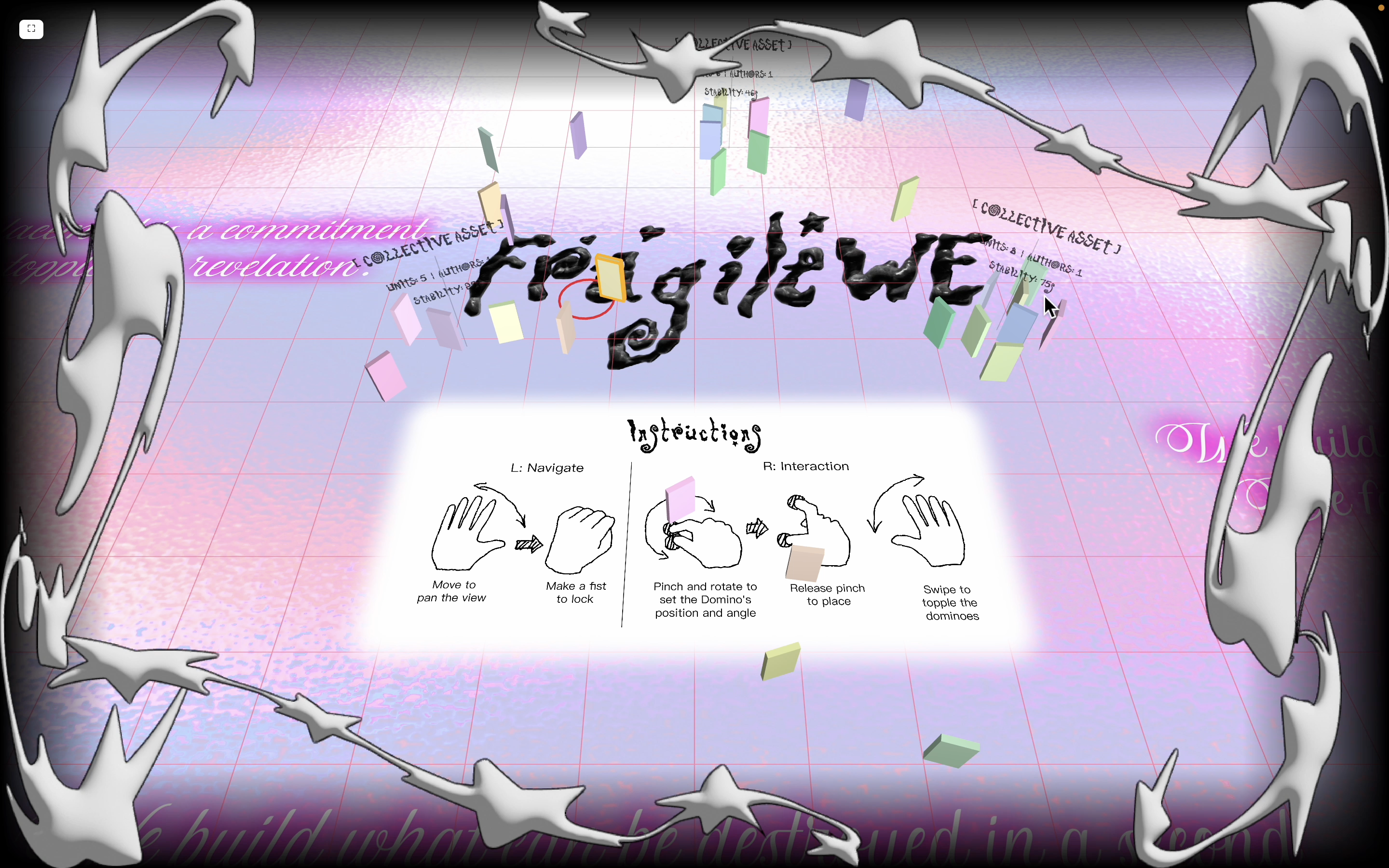
The Shift to Embodied Interaction: Playtesting revealed that traditional mouse clicks lacked the physical weight needed to convey the artistic metaphor of "fragility". To resolve this, I introduced computer vision via ml5.js (HandPose) to physically embody the interaction.

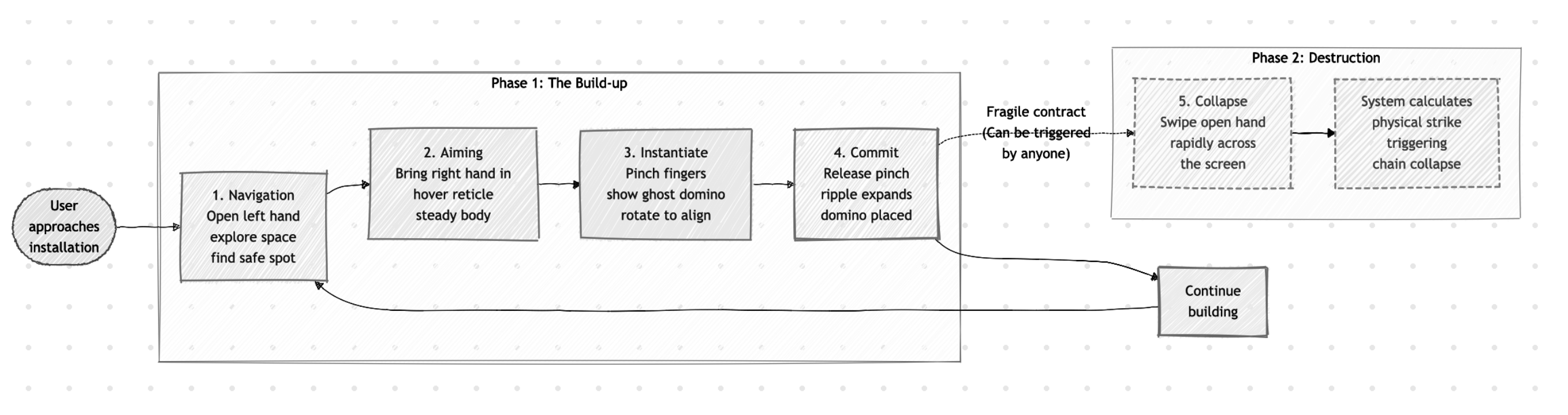
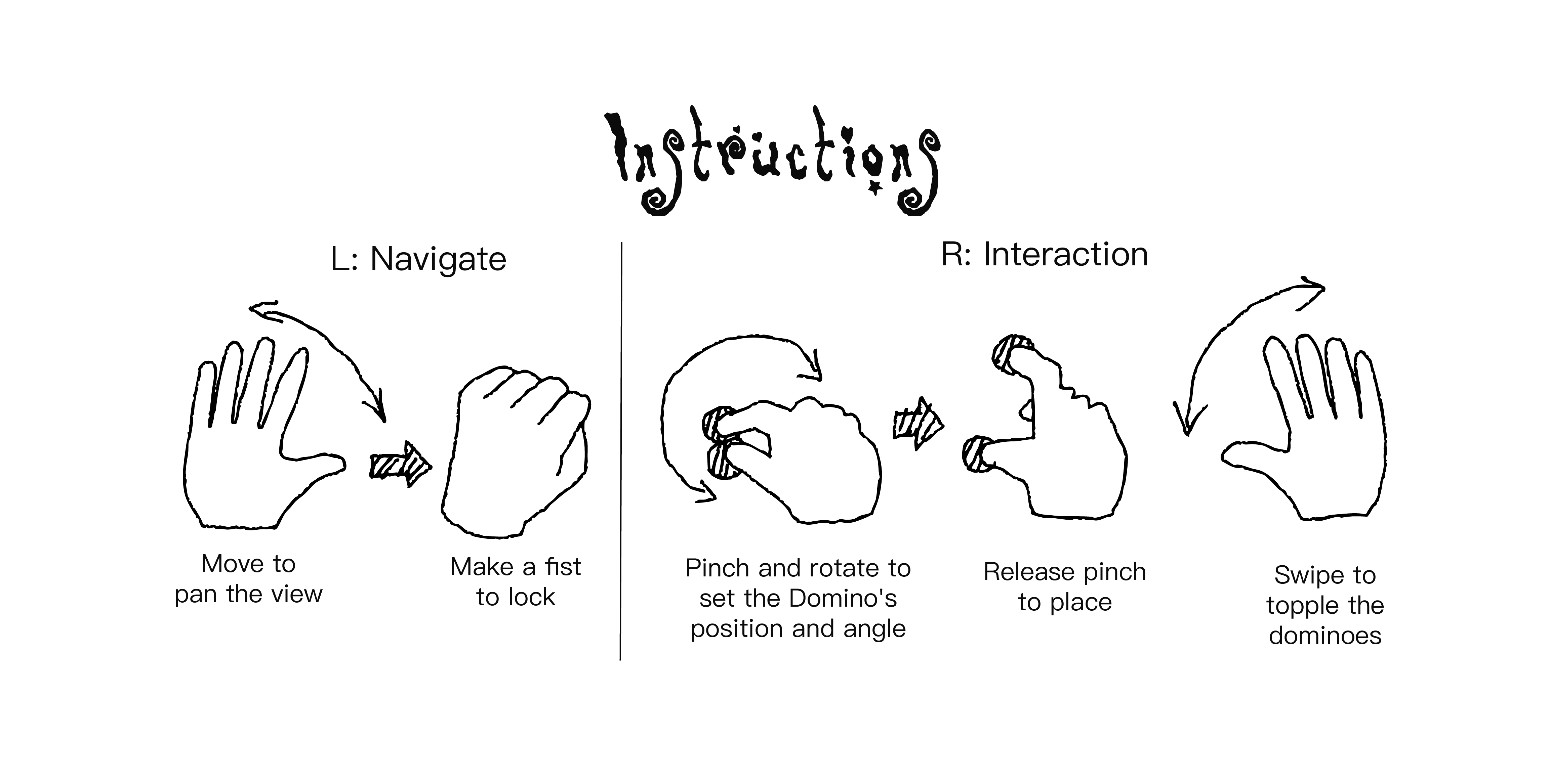
The Mechanic (The Build-up vs. Destruction): The interaction flow is an asymmetrical physical experience. To create, users must carefully navigate using an open left hand, and meticulously "pinch and rotate" with their right hand to place a domino, demanding physical tension and steadiness. Conversely, destruction is effortlessly brutal: a rapid, open-hand swipe registers as a physical strike, instantly triggering a catastrophic chain reaction that wipes out the collaborative effort.

Execution & AI

Developing 'FragileWE' required bridging frontend 3D rendering (p5.js), machine learning models (ml5.js), and backend real-time networking (Node.js/Socket.io) to synchronize the 'collective assets' across multiple anonymous clients.

In this process, I utilized Gemini as a crucial mathematical and syntax co-pilot. While the conceptual design and architecture remained my own, AI assisted in solving complex 3D coordinate projection algebra to map 2D hand-tracking data into a tilted WebGL space. Furthermore, AI was instrumental in formulating logical gates to accurately parse human intent—distinguishing between a delicate 'pinch' for placement and computing frame-by-frame velocity to accurately trigger the 'swipe' of destruction.

Project Video